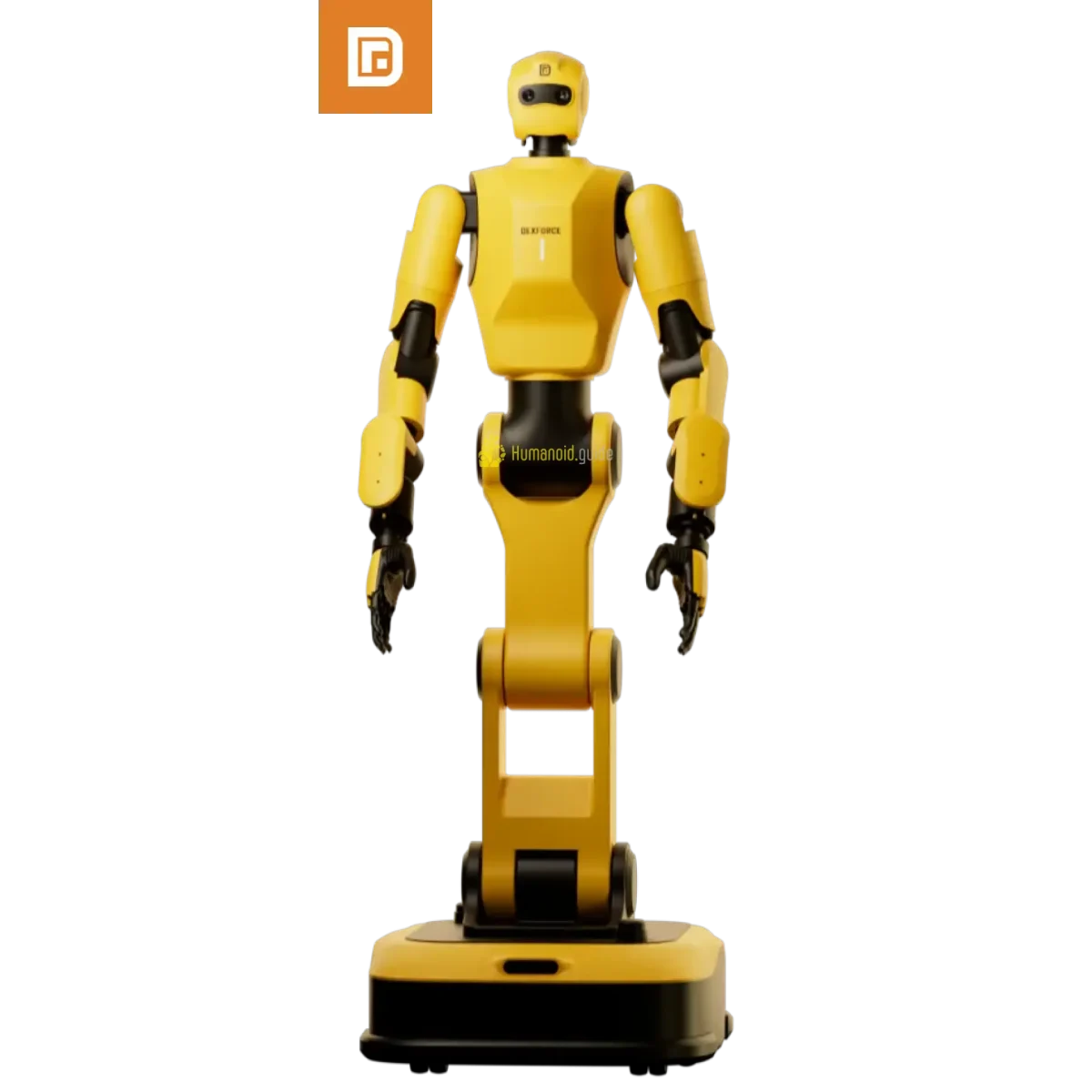
What is the W1 Pro Dexforce?
DexForce W1 Pro is a humanoid robot under development by DexForce Technology, a Chinese robotics company. It features 21-DOF dexterous hands and a VLA (Vision-Language-Action) policy trained on 50,000 hours of teleoperation data. The VLA policy integrates vision, language, and action for context-aware task execution, a benchmark for foundation models in robotics. The robot is designed for advanced manipulation and human-like interaction. No specifications like height, weight, battery life, or payload have been published, making direct comparison impossible. It was unveiled in 2024 and remains a pre-commercial prototype, not yet available for purchase. DexForce positions it as a platform for 'agile dexterity' backed by undisclosed funding.
Specifications
Here are the full technical specifications.
| Spec | Value |
|---|---|
| Height | Not specified |
| Weight | Not specified |
| Degrees of freedom | Not specified |
| Battery life | Not specified |
| Max speed | Not specified |
| Payload | Not specified |
| Price (new) | Undisclosed |
| Price (used range) | N/A |
Price & Value
New MSRP: Undisclosed
Used range: N/A
Pricing for the DexForce W1 Pro has not been publicly disclosed. As a high-DOF humanoid with a teleoperation-trained policy, it likely targets research labs and enterprise clients, positioning it alongside other advanced humanoids that cost $100,000–$300,000. Given the high cost of similar dexterous humanoids (e.g., Shadow Robot's hands alone cost over $100k), the W1 Pro could be priced anywhere from $150k to $500k. However, without hardware details, it's unclear if the robot can justify such an investment. Until official pricing is released, it's impossible to assess value against competitors like the Unitree G1 or Tesla Optimus. If competitively priced, the W1 Pro could appeal to institutions seeking advanced dexterity. Organizations considering the W1 Pro should engage with DexForce on pilot programs to understand real-world performance before committing. Total cost of ownership will also include software licensing, maintenance, and integration, which are typical for research-grade humanoids. The lack of used units means no depreciation data exists yet.
Who Is It For?
Best for: - Robotics research labs focusing on dexterous manipulation and teleoperation (21-DOF hands, large training dataset). - Organizations exploring VLA-based humanoid control and sim-to-real transfer. - AI companies developing embodied agents with VLA capabilities (50k-hour teleoperation dataset for policy bootstrapping).
Not for: - Industrial deployment requiring proven payload, speed, or reliability (no specs released). - Budget-constrained buyers seeking an off-the-shelf solution.
Alternatives & Comparison
The W1 Pro enters a crowded field of Chinese and American humanoids. The humanoid market in 2026 is dominated by Tesla's Optimus, Unitree's G1/H1, Figure, and Fourier, all with varying levels of dexterity. The W1 Pro's focus on hand complexity and teleoperation data sets it apart, but the lack of disclosed specs leaves potential buyers guessing about real-world feasibility.
| Model | Price | Available | Key Difference |
|---|---|---|---|
| Tesla Optimus | ~$100,000 (est.) | preorder | AI integration and known Gen 2 specs, but hands max 11 DOF |
| Unitree G1 | $16,000 | yes | Affordable and available with decent legs but limited manipulation (7-DOF hands) |
| Fourier GR-2 | ~$150,000 (est.) | enterprise-only | High-payload industrial with 12-DOF hands, not VLA-focused |
| Figure 02 | Undisclosed | preorder | Enterprise-oriented with 6-DOF grippers, more operational real-world data |
Verdict: If you need a humanoid with exceptional hand dexterity and are willing to wait for a commercially ready product, the W1 Pro is an intriguing prospect. For immediate deployment, established options like the Unitree G1 (budget) or Fourier GR-2 (industrial) are safer bets with known specs and support. If DexForce publishes specs and a reasonable price, it could become a compelling alternative for research labs.
Use Cases & Capabilities
Dexterous Manipulation Research
The 21-DOF hands enable complex object grasping, in-hand manipulation, and tool use that few humanoids can match. Researchers can study advanced control algorithms, tactile sensing integration, and reinforcement learning by leveraging the rich hand kinematics. The VLA policy provides a strong baseline for sim-to-real transfer, potentially accelerating development. However, the lack of published payload and grip force limits understanding of real-world capability.
Teleoperation & Data Collection
The W1 Pro is built on 50,000 hours of teleoperation data, suggesting its design is optimized for human-in-the-loop control. This makes it suitable as a platform for gathering additional training data across diverse tasks, which can be used to improve autonomous policies. Labs aiming to build large-scale manipulation datasets could deploy the robot for remote operation. Without production availability, this use case remains speculative but aligned with current AI training trends.
Foundation Model & Policy Training
With its VLA architecture, the W1 Pro serves as a testbed for end-to-end learning from vision to action. The 50,000-hour dataset provides a starting point for fine-tuning on custom tasks, reducing the need for massive in-house data collection. Researchers can explore multi-modal instruction following, long-horizon task planning, and Sim2Real transfer. The robot’s 21-DOF hands allow dexterous demonstrations necessary for training complex manipulation policies. However, access to the policy and dataset may be restricted, limiting third-party research.
History & Background
DexForce Technology, a Chinese robotics startup, first revealed the W1 Pro humanoid in 2024. The robot garnered attention for its 21-DOF hands—more dexterous than most competitors—and a VLA policy trained on 50,000 hours of teleoperation. DexForce emerged from stealth, possibly a spin-off from a Chinese university or robotics lab, though specifics remain unverified. The W1 Pro was announced via a brief online reveal, showcasing simulated and teleoperated demos. The 21-DOF hands incorporate high-torque actuators and tactile sensors, according to limited technical briefs. No further hardware details or commercial release dates have been announced. Since then, the company has remained quiet, fueling speculation about production challenges or strategic pivots. Industry observers note that many humanoid startups face long development cycles, and the W1 Pro's silence may be normal. Despite hype in niche robotics circles, the lack of transparency has led to skepticism about near-term commercial viability. The robot was showcased in concept videos but no live demos have been widely reported.
Buying Used — What to Check
Confirm hand DOF 21-DOF hands are a key selling point; verify the actual number of degrees of freedom on production units.
Request battery life and payload specs Without these, assessing utility is impossible; ensure they meet your use case.
Ask about software stack maturity The VLA policy and APIs may still be under development; clarify support and licensing.