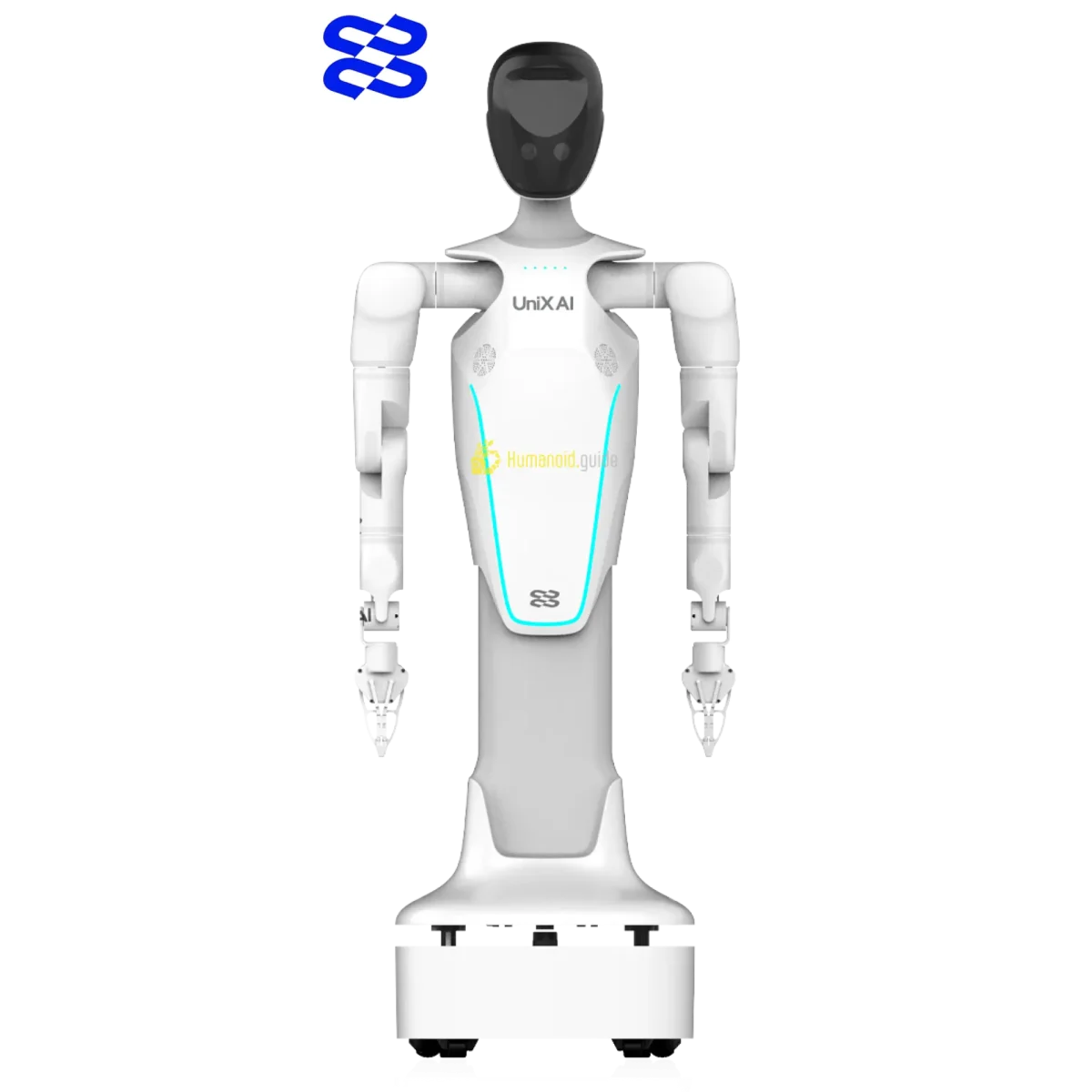
What is the Wanda 2?
UniX AI Wanda 2.0 is a mobile manipulator humanoid robot developed by Chinese startup UniX AI, headquartered in China. Designed explicitly for household and consumer robotics, the robot stands 142 cm tall, features 22 degrees of freedom spread across two arms with two-finger gripping claws, and moves on an omnidirectional wheeled base. An RGBD camera array and Linux-based robotics framework (likely ROS/ROS2) provide perception, while an integrated large language model enables conversational interaction. Wanda 2.0 is engineered for tasks like cleaning, laundry, and cooking, representing a focused bet on home-service automation. As of 2026, the platform remains a pre-commercial prototype with no firm release date.
Specifications
Here are the full technical specifications.
| Spec | Value |
|---|---|
| Height | 142 cm |
| Weight | Not specified |
| Degrees of freedom | 22 |
| Battery life | 8 hours |
| Max speed | 5.4 km/h |
| Payload | 12 kg |
| Price (new) | Undisclosed (contact manufacturer) |
| Price (used range) | N/A |
Price & Value
New MSRP: Undisclosed
Used range: N/A
UniX AI has not disclosed pricing for Wanda 2.0, as it remains a prototype. Given its target of household use and built-in AI capabilities, the final product could be priced competitively against other service humanoids, though no comparable home-only robots exist at scale. If UniX follows a leasing model or subscription pricing, total cost of ownership could be unpredictable. Buyers should monitor official announcements closely. As production advances, depreciation will be unknown until first units ship. Compared to general-purpose humanoids like Unitree G1, Wanda 2.0 may aim for a lower price point to penetrate consumer markets, but any projection is speculative.
Who Is It For?
Best for: - Early adopters evaluating home robot prototypes - Households interested in future daily chore automation
Not for: - Immediate purchase or deployment (not yet commercially available) - Industrial heavy-lifting tasks (only 12 kg payload)
Alternatives & Comparison
Wanda 2.0 competes in the emerging household humanoid segment, but currently only a few robots address home assistance. Compare it to mobile manipulators and legged humanoids that might serve similar roles.
| Model | Price | Available | Key Difference |
|---|---|---|---|
| Unitree G1 | Undisclosed | preorder | Legged, general‑purpose humanoid; not specifically designed for home chores |
| Stanford Mobile ALOHA | Undisclosed (research platform) | no | Open‑source wheeled bimanual research robot, not a commercial product |
| Richtech ADAM | Undisclosed | yes | Commercial wheeled dual‑arm robot for hospitality and service, not dedicated to home chores |
Verdict: Currently, no direct competitor matches Wanda 2.0’s explicit focus on household tasks. Unitree G1 is a more advanced general‑purpose platform but still in early stages. Buyers seeking a dedicated home assistant will need to wait for Wanda 2.0 to mature beyond the prototype phase; meanwhile, hobbyists might explore DIY platforms like Mobile ALOHA.
Use Cases & Capabilities
Home Chore Automation
Wanda 2.0 is purpose‑built to handle domestic drudgery: it can load and unload dishwashers, fold laundry, wipe surfaces, and prepare simple meals. Its wheeled base allows it to navigate single‑floor homes without stairs, while the 12 kg payload arm strength is sufficient for most household objects. The integrated LLM enables voice‑instructed task sequences, though real‑world reliability in cluttered kitchens remains untested. As a prototype, current demonstrations show conceptual capability, but full autonomous performance across diverse home layouts is still under development.
Elderly and Mobility Assistance
For seniors or individuals with limited mobility, Wanda 2.0 could serve as a non‑medical companion that fetches items, opens cabinets, and performs light cleaning. The robot’s natural language interface reduces the learning curve, and its safe‑operation design (aluminum frame with composite covers) provides peace of mind. However, the lack of stair‑climbing ability limits it to accessible single‑story dwellings. Regulatory approvals for private‑home deployment are not yet secured, so this use case remains aspirational until commercial release.
Research Platform for Home Robotics
Universities and corporate R&D labs evaluating service robotics could adopt Wanda 2.0 as a testbed for AI‑driven home assistance. Its RGBD vision, 5G/Wi‑Fi connectivity, and Linux‑based ROS framework offer a familiar development environment. The 22‑DOF bimanual setup provides richer manipulation possibilities than single‑arm mobile bases. Yet, as a closed prototype with no open‑source commitment, research access will depend on partnership agreements with UniX AI, and long‑term support is uncertain.
History & Background
UniX AI was founded in 2023 in China with the mission to commercialize humanoid robots for everyday home use. The Wanda platform emerged as the company’s core product line, starting with an initial version that showcased basic manipulation and speech. Wanda 2.0 was unveiled in 2025, featuring a larger torso display, more natural conversational AI, and a refined 22‑DOF kinematic design. The robot was demonstrated performing laundry and cleaning tasks in staged environments. As of 2026, Wanda 2.0 remains an active prototype in development; no mass‑production date or pilot customer announcements have been made. UniX AI continues to improve the platform while seeking strategic partnerships to bring home humanoids to market.
Buying Used — What to Check
Verify hardware maturity Prototype robots often lack long‑term reliability; confirm upgrade history and availability of replacement parts.
Confirm software stack Ensure the Linux‑based LLM integration is fully operational and not locked to demo programs only.
Check battery health Claimed 8‑hour runtime may degrade in early units; test actual cycle life before purchase.