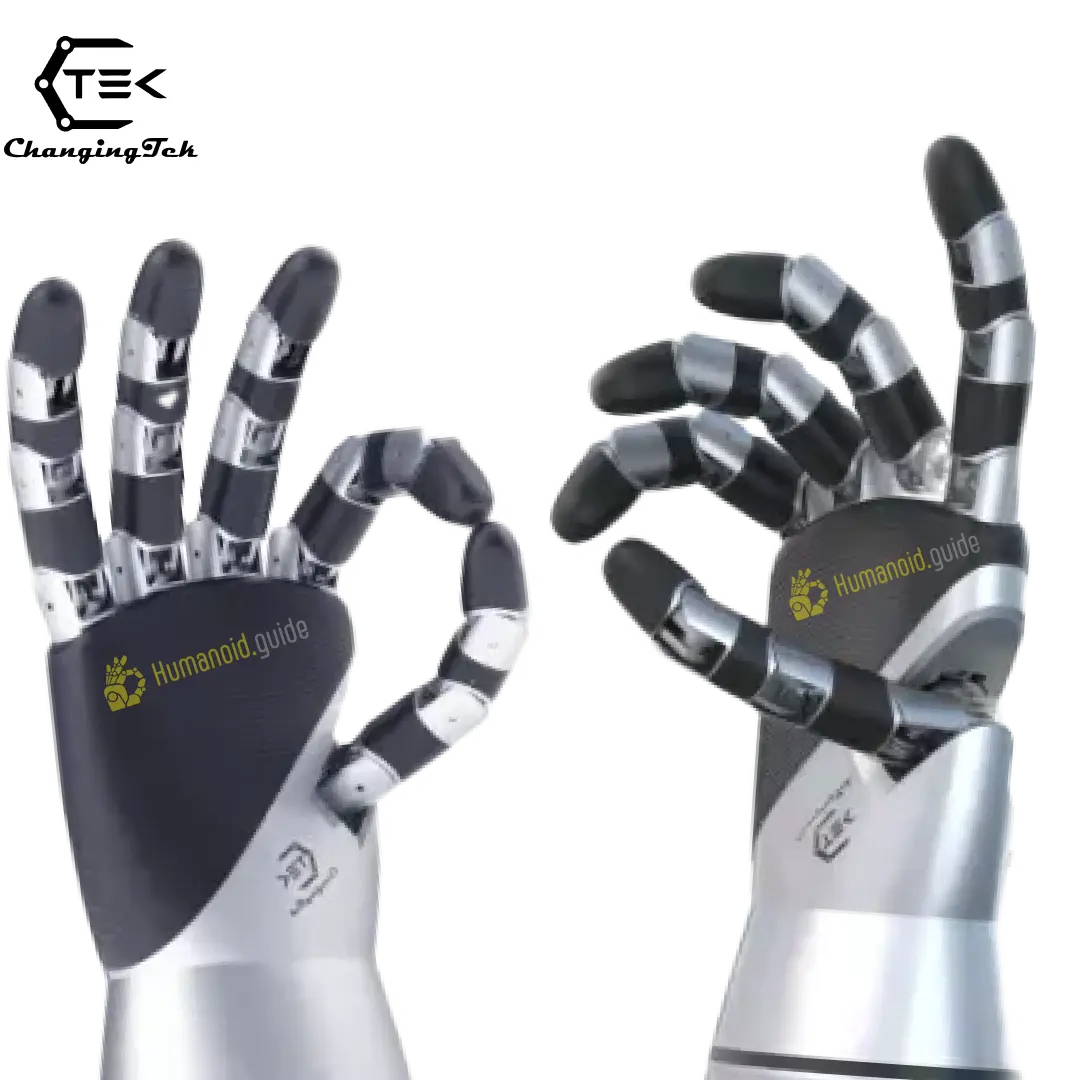
What is the X2 Robotic Hand?
The Changingtek X2 is an adaptive dexterous robotic hand designed for humanoid robots and industrial automation applications. Manufactured by Changingtek Robotics Technology (Suzhou) Co., Ltd., based in Suzhou, China, it features 5 fingers and 16 degrees of freedom, enabling precise manipulation and grasping. A standout feature is its ability to automatically switch between left- and right-hand configurations, simplifying integration into dual-arm setups. The hand uses a tendon-driven actuation system, tactile and force sensors, and a durable aluminum alloy/high-strength polymer structure. It weighs just 1.2 kg and can lift payloads up to 5 kg, making it a versatile end-effector for adaptive tasks.
Specifications
Here are the full technical specifications.
| Spec | Value |
|---|---|
| Height | 60 mm |
| Weight | 1.2 kg |
| Degrees of freedom | 16 |
| Battery life | N/A (tethered) |
| Max speed | N/A |
| Payload | 5 kg |
| Price (new) | $14,000 |
| Price (used range) | $10,000 — $13,000 (est.) |
| Dimensions | 200 × 110 × 60 mm |
Price & Value
New MSRP: $14,000
Used range: $10,000 — $13,000 (est.)
At $14,000, the X2 sits in the mid-range for dexterous robotic hands. Industrial alternatives like Schunk’s SVH 5-finger hand can cost up to $40,000, while research-oriented hands like the Shadow Dexterous Hand exceed $100,000. For budget-sensitive applications, the X2 offers strong value with its automatic ambidextrous switching and integrated sensors. Used units, typically priced 10–20% lower, are rarely available due to limited volume, but BotMarket can surface private listings. Total cost of ownership is low given its tethered power, eliminating battery replacement, and standard communication interfaces. Buyers should budget an extra $500–$1,000 for mounting adapters and cables.
Who Is It For?
Best for: - Humanoid robot developers requiring dual-arm manipulation with automatic left/right hand adaptation - Industrial automation integrators seeking a lightweight, 5 kg payload hand for pick-and-place tasks - COTS humanoid robot builders requiring sensor-rich hands - Research labs studying dual-arm coordination or reinforcement learning
Not for: - Applications needing onboard battery power (tethered only) - Heavy lifting beyond 5 kg sustained payload - Outdoor mobile robots (tethered power restricts range)
Alternatives & Comparison
The Changingtek X2 competes with other dexterous hands in the sub-$20,000 range, offering unique auto-switching and integrated sensory feedback.
| Model | Price | Available | Key Difference |
|---|---|---|---|
| Wonik Allegro Hand | ~$30,000 | yes | Four fingers, higher grip strength but lacks auto left/right switching. |
| Robotiq 3-Finger Adaptive Gripper | ~$12,000 | yes | Only 3 fingers; less dexterity but more robust for heavy industrial use. |
| Schunk SVH 5-Finger Hand | ~$40,000 | yes | 20 DOF, premium build, but heavier and no automatic hand switching. |
Verdict: For integrators needing ambidextrous operation at a mid-level price, the X2 is unmatched. The Allegro Hand provides 4 fingers and similar DOF but at nearly double the cost and without auto-switching. The Robotiq 3-Finger Gripper is cheaper but sacrifices humanoid form factor and sensor sophistication. The Schunk SVH offers premium quality but costs three times as much and lacks auto-switching. Overall, the X2 wins for cost-effective humanoid hand integration, while the Schunk is better for harsh industrial environments requiring higher payloads.
Use Cases & Capabilities
Humanoid Bimanual Manipulation
The X2 shines in humanoid platforms like the Unitree H1 or Fourier GR-2 that require dual hands. Its auto left/right switching eliminates the need for separate mirror-image models, reducing inventory complexity. The 16 DOF allow fine finger motions such as pinching, wrapping, and power grasps. Force/tactile sensors feed back grip pressure, critical for handling eggs or electronics. The 1.2 kg low weight helps maintain arm dynamics during fast movements. Integration with ROS and common motor drivers makes it approachable for custom builds.
Industrial Pick-and-Place
In manufacturing, the X2 can unload parts from CNC machines or sort packages on conveyor belts. The 5 kg payload covers small metal parts, plastic components, and packaged goods. Its tendon-driven design provides compliance, reducing damage from misalignment. The aluminum alloy frame withstands 24/7 operation in dry environments. Since it is tethered, cabling must be routed along the robot arm. Used with vision systems, the X2 enables adaptive grasping without pre-programmed positions.
Research and Development
Robotics labs leverage the X2 to experiment with reinforcement learning for dexterous policies. The 16 DOF and sensors enable complex in-hand manipulation benchmarks. At $14,000, it is far more accessible than the Shadow Hand ($120k+) while offering similar DOF count. Open-source ROS packages allow rapid prototyping with Python or C++. The auto-switch feature doubles the value for bilateral teleoperation studies. Researchers can also 3D-print custom fingertips for specific tasks.
Medical and Rehabilitation Robotics
Prosthetic device developers use the X2 as a research platform for advanced hand components. Its lightweight and compliant design mimic human tendon transmission. Force sensors enable closed-loop control for patient safety. While not FDA approved, it provides a realistic testbed for future medical robots. The hand's ability to reconfigure for left/right anatomy suits above-elbow prosthetic studies.
Collaborative Robot Integration
Cobot arms like Universal Robots UR5 can mount the X2 to handle small items near humans. The built-in safety between tendons and sensors reduces pinch hazards. The 5 kg payload matches typical cobot payload specs, enabling gentle assembly tasks like electronics insertion. The tethered power and communication simplify electrical integration. With automatic hand switching, a single cobot cell can switch between left and right tasks without swapping end-effectors.
Retail and Warehouse Order Picking
In e-commerce fulfillment, the X2 can handle irregular items like clothing, books, or packaged food. Its adaptive grasp avoids damage to fragile goods. Coupled with a 6-axis arm, it can pick from bins and place into shipping cartons. The 5 kg payload covers most consumer goods below that weight. Auto-switching allows one robot to handle both left-hand and right-hand oriented pick positions. Although slower than dedicated suction grippers, the X2 offers superior flexibility.
Aerospace and Electronics Assembly
Precision assembly tasks in cleanrooms benefit from the X2's compliant grasp. Small components like connectors or circuit boards can be manipulated without mechanical damage. The tactile sensors can verify placement force during insertion. The hand's aluminum alloy and polymer materials are compatible with cleanroom protocols. While not intrinsically safe for explosive environments, it can operate in static-controlled areas.
History & Background
Changingtek Robotics Technology (Suzhou) Co., Ltd. emerged from China's growing robotics sector in the late 2010s. The company's founding year is not publicly documented, but it established itself as a specialist in adaptive gripping solutions. The X2 was introduced as part of their 'Dextrous Hand Series' to cater to the humanoid robot boom. Its development was driven by the need for cost-effective hands that could automatically switch between left and right configurations—a feature that eliminates duplicates. The X2 gained attention through listings on platforms like Humanoid.guide and has been showcased at Chinese automation expos. As of 2026, Changingtek offers a range of hands from heavy-duty to industrial parallel grippers, positioning itself for both industrial and research markets.
Buying Used — What to Check
Verify payload rating Payload and tactile sensors are critical for safe operation; confirm calibration and test under load.
Inspect tendon wear Tendon-driven systems degrade over time; check for fraying, stiffness, or reduced range of motion.
Test left/right switching The automatic hand switching mechanism must be reliable; verify smooth reconfiguration and sensor feedback.


