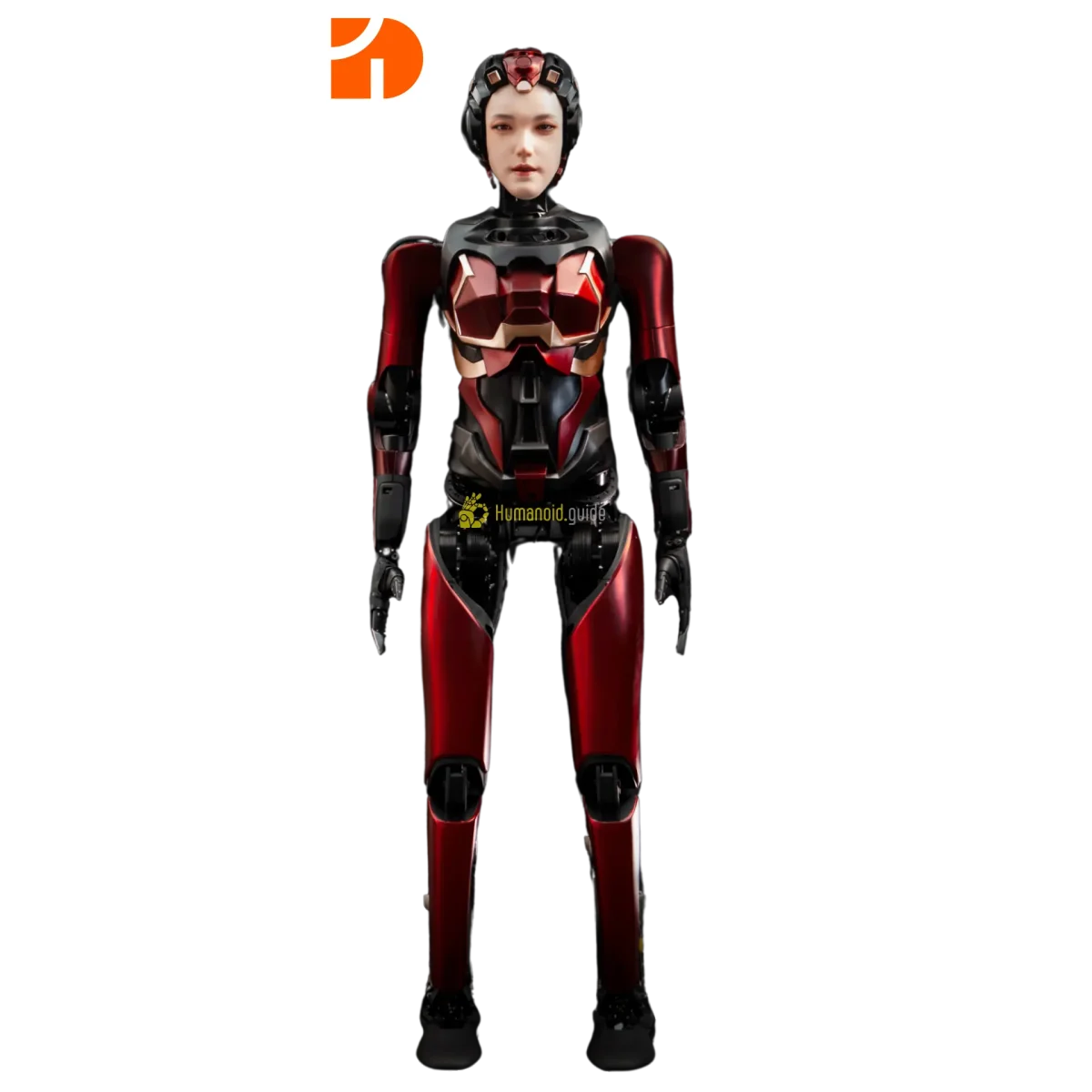
What is the Xialan S0?
The Xialan S0 is a compact humanoid robot designed by Digit Robotics, a Chinese manufacturer, for domestic assistance and research. Standing 169 cm tall and weighing an undisclosed amount, it features a red aluminum alloy frame with composite panels. With 40+ degrees of freedom (29+ in hands), it uses high-torque electric servo actuators and harmonic drive systems for precise, quiet movement. Its Linux-based software (likely ROS/ROS2) allows real-time control and external AI integration. Targeted at academic labs and embodied AI developers, it offers a balance of dexterity and affordability for cutting-edge robotics experiments.
Specifications
Here are the full technical specifications.
| Spec | Value |
|---|---|
| Height | 169 cm |
| Weight | Not specified |
| Degrees of freedom | 40+ |
| Battery life | 2 hours |
| Max speed | 4.5 km/h |
| Payload | 8 kg (arm) |
| Price (new) | $90,000 |
| Price (used range) | N/A |
Price & Value
New MSRP: $90,000
Used range: N/A
The Xialan S0 is priced at $90,000, positioning it among the most affordable full-size research humanoids. This directly competes with the Unitree H1 (~$90,000) and is significantly below the Fourier GR-1 (~$150,000). It offers strong dexterity (40+ DOF) at a point that makes it accessible to university labs and small R&D teams. As a pre‑commercial prototype, resale value is uncertain; early adopters may face rapid depreciation once production volumes increase and newer models emerge. Total cost of ownership should account for a dedicated Linux‑based development environment and potential custom integration. For labs on a budget, the S0 represents a compelling value proposition against heavier, more expensive alternatives.
Who Is It For?
Best for: - University robotics labs (40+ DOF enables dexterous manipulation research) - Embodied AI developers needing a physical platform for language-model integration - Academic groups exploring humanoid locomotion with a 4.5 km/h walking speed - Organizations prototyping domestic service robots with an 8 kg arm payload
Not for: - Heavy industrial tasks (no published total standing payload rating) - Production environments requiring 8+ hour continuous operation (only 2-hour battery life) - Buyers needing immediate delivery (still a prototype with no commercial release date)
Alternatives & Comparison
The Xialan S0 enters a growing market of research‑oriented humanoids, competing with established machines like the Unitree H1 and Fourier GR‑1. While still a prototype, its spec sheet positions it as a strong contender for labs focused on dexterity and safe interaction.
| Model | Price | Available | Key Difference |
|---|---|---|---|
| Unitree H1 | ~$90,000 | yes | Commercially available, 51 DOF, higher joint torque, IP54 protection |
| Fourier GR-1 | ~$150,000 | yes | 54 DOF, 50 kg payload, proven multi‑robot orchestration software |
Verdict: For labs prioritizing dexterity and a lower price, the Xialan S0 is a strong contender—if you can wait for commercial release. However, the Unitree H1 is available now with a similar price and proven reliability. The Fourier GR-1 offers higher payloads and a more established platform, but at a significant cost premium. Until Digit Robotics delivers on its promises, the Unitree H1 remains the safest bet for immediate research needs.
Use Cases & Capabilities
University Robotics Research
The S0's 40+ degrees of freedom, especially the 29+ in its hands, make it ideal for dexterous manipulation studies. Graduate students can program grasping, in‑hand object rotation, and tool‑use tasks using ROS/ROS2. Its compact height (169 cm) and safe torque‑limited actuators allow close human interaction during experiments. The 2‑hour battery supports typical lab session lengths, though researchers may need to schedule around recharging. Its Linux‑based architecture simplifies custom algorithm deployment for papers on reinforcement learning or visual servoing.
Embodied AI Development
The S0's ability to interface with external large language models turns it into a physical testbed for conversational and task‑planning AI. Developers can integrate vision‑language models to enable the robot to interpret natural language commands and execute household chores. The robot's quiet electric actuators are a plus for indoor environments where speech recognition matters. With Wi‑Fi and Ethernet connectivity, cloud‑based AI processing is straightforward, though latency considerations may require on‑board GPU add‑ons. This makes the S0 a potential platform for companies exploring the next generation of service robots.
Humanoid Locomotion Studies
With a top speed of 4.5 km/h and a walking speed of 4 km/h, the S0 provides a realistic bipedal platform for gait generation and dynamic balancing experiments. The harmonic drive‑based actuators offer high backdrivability, essential for compliant locomotion control. Researchers can test whole‑body motion planning in a platform that mirrors human proportions, albeit with a currently undisclosed weight that may affect stability simulations. The robot's aluminum‑composite frame keeps it relatively light, facilitating faster prototyping of walking algorithms without the safety risks of heavier machines.
Domestic Assistance Prototyping
Digit Robotics positions the S0 as a compact home assistant prototype, capable of performing tasks like picking up objects, wiping surfaces, and organizing items. Its 8 kg arm payload lets it handle typical household items, from books to grocery bags. Quiet operation and a red, friendly appearance aim to promote user acceptance. While still a prototype, the S0's design choices suggest a future where robots collaborate with humans in living spaces, though the lack of a commercial roadmap means deployment in real homes remains distant.
History & Background
Digit Robotics, based in China, unveiled the Xialan S0 in 2024 as a compact humanoid for home assistance and research. The company’s founding date and background remain undisclosed, though its domain (digit.com.cn) appears dedicated to this single product line. The S0 prototype was first demonstrated in 2024, highlighting quiet harmonic‑drive actuation and delicate hand dexterity—29+ DOF across five‑fingered hands. Since then, limited technical updates have been released, with the robot remaining in the development phase. Unlike larger industrial humanoids, the S0 is optimized for indoor environments and safe human‑robot cooperation. No subsequent generations or variants have been announced. The project reflects China’s growing investment in embodied AI, joining other domestic efforts like Fourier’s GR‑1 and Unitree’s H1. As of 2026, Digit Robotics has not disclosed any production timeline or pre‑order program, keeping the S0 firmly in prototype status.
Buying Used — What to Check
Confirm prototype origin Since no commercial S0 units exist, any used listing would be an unreleased prototype; verify serial numbers and manufacturer authorization to avoid legal issues.
Request actuation hours and test logs Prototype units may have high accumulated wear on harmonic drives and servo controllers; obtain maintenance records to assess remaining lifetime.
Verify software stack accessibility The S0 runs a custom Linux framework; ensure that full source code, ROS drivers, and recovery images are included, as after‑market support from Digit Robotics may be limited.