
Qualcomm and Neura Robotics have announced a partnership to build next-generation humanoid robots on Qualcomm's newly released IQ10 processor platform. The deal positions Neura as a first mover on dedicated robotics silicon — and signals that the semiconductor-to-robot pipeline is becoming a defining battleground in physical AI.
What Is Qualcomm's IQ10 Processor and Why Does It Matter for Robotics?
The Qualcomm IQ10 is purpose-built silicon for intelligent robotics — not a repurposed mobile chip, not a repackaged automotive SoC. Announced at CES, it targets the real-time sensor fusion, low-latency motor control, and on-device AI inference that humanoid robots demand. For a market that has largely run on adapted GPU clusters or generic embedded processors, dedicated robotics silicon is a meaningful shift.
The distinction matters more than it might initially appear. General-purpose chips carry overhead — power budgets, memory architectures, and thermal envelopes designed for different workloads. A humanoid robot operating in a warehouse or care facility needs millisecond-level decision loops, simultaneous processing of visual, tactile, and proprioceptive (body-position) data, and enough on-device AI capability to act without a cloud connection. The IQ10 is architected around those constraints from the ground up.
Qualcomm hasn't published full benchmark figures for the IQ10 in robotics deployments, but the platform's positioning mirrors what the company achieved in mobile with Snapdragon: own the silicon layer, and everything built above it inherits structural advantages in performance per watt.
Why Neura Robotics Chose Qualcomm Over Competing Chip Platforms
Neura's partnership with Qualcomm makes Neura an anchor customer for a platform that Qualcomm intends to scale across the robotics industry. That's a calculated bet on both sides — Neura gets early access to optimised toolchains and silicon capabilities before competitors, while Qualcomm gets a credible humanoid showcase for the IQ10.
The competitive landscape for robotics chips is crowding fast. NVIDIA's Jetson and Thor platforms are already embedded in dozens of robot platforms. Intel, Arm, and a wave of AI chip startups are all angling for robotics design wins. Qualcomm's differentiation pitch leans on its decade of work in mobile edge AI — the same low-power, high-throughput inference architecture that runs on hundreds of millions of smartphones now has a direct line to robotics applications.
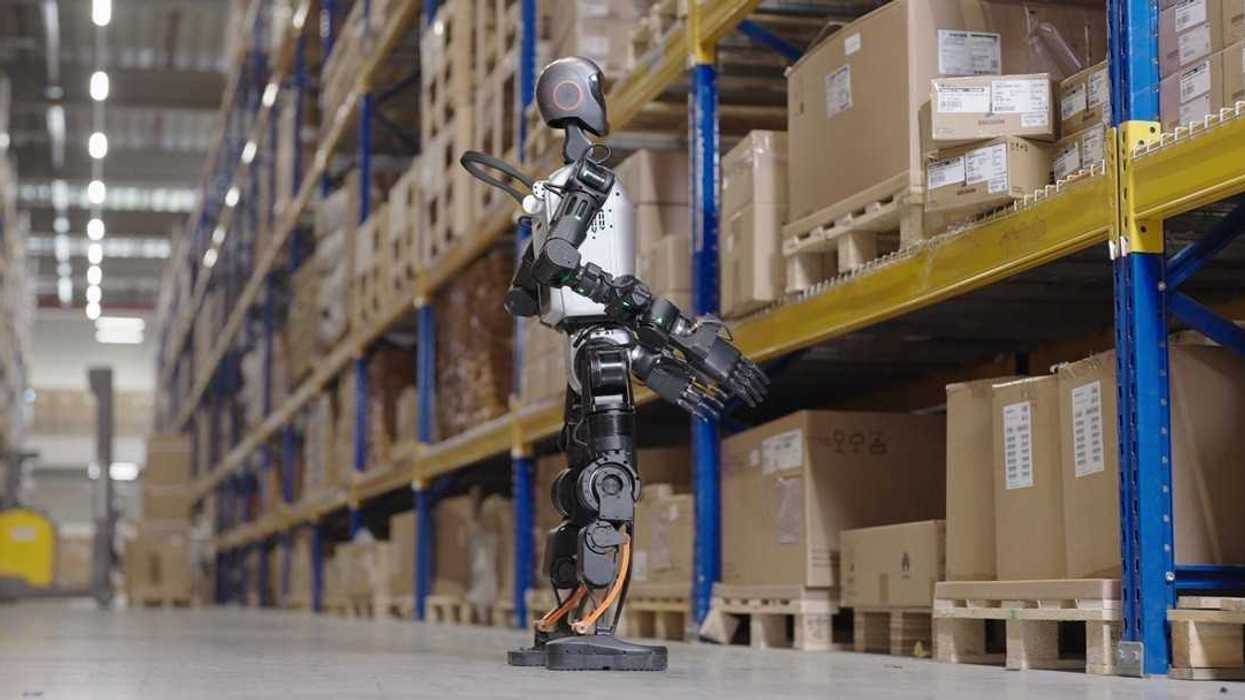
For Neura specifically, the choice reflects a broader strategic direction. The German robotics company, founded by David Reger, has built its MAiRA and 4NE-1 humanoid platforms around the premise that cognitive capability — the ability to understand context and adapt — separates next-generation robots from scripted automation. Running that cognition on purpose-built, on-device silicon rather than offloading to the cloud reduces latency, improves reliability in connectivity-poor environments, and keeps operational data local. All three matter to enterprise buyers.
How Dedicated Silicon Is Reshaping Humanoid Robot Architecture
The conventional approach to humanoid robot compute has been to stack capable but generic hardware — Jetson modules for perception, separate microcontrollers for motor control, sometimes cloud inference for higher-level reasoning. It works, but it's architecturally fragmented. Latency accumulates at every interface. Power budgets balloon. Integration complexity drives up development timelines.
Dedicated robotics processors like the IQ10 compress that stack. Think of it as the difference between a purpose-built racing engine and a production engine tuned for track use — both can lap a circuit, but one was designed for the specific stress profile from the start. The analogy has limits: in robotics, the "track" changes constantly, so adaptability matters alongside raw performance. The real test for the IQ10 will be how well its AI accelerators handle novel environments, not just benchmarked lab conditions.
| Compute Approach | Latency Profile | Power Efficiency | On-Device AI | Integration Complexity |
|---|---|---|---|---|
| Generic GPU (e.g. Jetson Orin) | Moderate | Moderate | Strong | High |
| Cloud-offload architecture | High (network-dependent) | High (edge device lean) | Limited | Very High |
| Dedicated robotics SoC (IQ10) | Low | High | Strong | Low–Moderate |
| Multi-chip fragmented stack | High (inter-chip overhead) | Low | Variable | Very High |
The table above illustrates why the industry is watching dedicated silicon closely. Lower latency and lower integration complexity compound: they speed up development cycles, reduce failure modes, and shrink the bill-of-materials for compute subsystems — all of which matter when humanoid robot unit economics are still being worked out at scale.
What This Means for Robotics Buyers and the Humanoid Market
For buyers evaluating humanoid robots now or in the near term, the Qualcomm-Neura partnership is a signal worth tracking — not an immediate purchasing trigger. Neura's new IQ10-based robots are not yet shipping; the partnership announcement marks a development commitment, not a product launch.
What it does clarify is the direction of the humanoid market's compute layer. Platforms built on purpose-designed silicon will carry structural advantages in power efficiency and on-device AI capability over the current generation of hardware. Buyers committing to multi-year deployment contracts today should ask vendors directly about their silicon roadmap — a robot running on a dedicated AI processor in two years will have meaningfully different operational characteristics than one running on adapted mobile or automotive chips.
For procurement teams, the practical implications include:
- Latency and responsiveness in dynamic environments (human co-working spaces, unstructured warehouses) will improve on dedicated silicon platforms
- Connectivity dependence decreases as on-device inference gets stronger — relevant for facilities with constrained networking
- Software ecosystem lock-in is a real consideration: Qualcomm's toolchain will optimise for IQ10, which shapes what third-party integrations and updates look like over time
- Total cost of ownership may shift as power-efficient silicon reduces energy draw — though exact figures won't be available until IQ10-based platforms are benchmarked in real deployments
If you're actively evaluating humanoid and advanced collaborative robot platforms, browse humanoid robots on Botmarket to compare currently available systems — including Neura's existing lineup — while next-generation silicon-native platforms come to market.
The broader industry signal is that semiconductor companies are now competing for the robotics stack the same way they competed for the smartphone stack a decade ago. Whoever owns the reference silicon for humanoid robots will influence the software ecosystem, the toolchain standards, and ultimately the pace of capability improvement across the entire market. Qualcomm is making a deliberate move to be that company. Neura is its first proof point.
Frequently Asked Questions
The Qualcomm IQ10 is a purpose-built system-on-chip (SoC) for intelligent robotics applications, announced at CES. It is architected for real-time sensor fusion, low-latency motor control, and on-device AI inference — workloads that general-purpose mobile or automotive chips handle with significant overhead penalties in power and latency.
Which Neura Robotics products will use the IQ10 chip?
Neura Robotics has committed to building new robot platforms on the Qualcomm IQ10, but specific product names and release timelines have not been publicly disclosed as of the partnership announcement. Neura's existing platforms — including the MAiRA collaborative robot and the 4NE-1 humanoid — were developed on prior hardware generations.
How does the Qualcomm-Neura partnership affect competing humanoid robot makers?
The partnership gives Neura early access to Qualcomm's IQ10 toolchain and silicon optimisations, providing a potential time-to-market advantage over competitors building on generic platforms. Other humanoid makers — including those using NVIDIA Jetson or Thor platforms — will need to respond either by deepening their own silicon partnerships or demonstrating that their existing compute architectures remain competitive on performance-per-watt benchmarks.
Why does dedicated robotics silicon matter for enterprise buyers?
Purpose-built robotics chips reduce latency between perception and action, improve power efficiency, and enable stronger on-device AI inference without cloud dependency. For enterprise deployments in environments with variable connectivity — manufacturing floors, logistics facilities, healthcare settings — these characteristics directly affect reliability and operational cost over a multi-year deployment horizon.
Is Qualcomm the only company building dedicated robotics processors?
No. NVIDIA's Jetson and Thor platforms are widely deployed in robotics. Arm licenses processor architectures used across embedded robotics. Several AI chip startups are also targeting robotics workloads. Qualcomm's differentiation is its heritage in mobile edge AI and its pitch that the IQ10 was designed specifically for robotics from the ground up, rather than adapted from another market segment.
The Qualcomm-Neura partnership marks a concrete step toward a semiconductor-defined humanoid market — where the chip architecture underneath a robot shapes its capabilities as fundamentally as its mechanical design. The first-mover advantage Neura is building may prove short-lived as the broader industry races to lock in silicon partnerships. But the direction is clear: physical AI runs on purpose-built silicon, and the companies that establish those foundations now will set the pace.
Which humanoid platform do you think benefits most from dedicated robotics silicon — and does it change your evaluation timeline?



Bergabung dalam diskusi
Which humanoid platform benefits most from dedicated silicon — and does it shift your buying timeline?