
Humanoid robots can now complete a half-marathon faster than most amateur human runners — and the 100-metre sprint world record may be next to fall. But as robot manufacturers chase athletic benchmarks, a harder question is emerging: does raw speed actually translate into value on a warehouse floor or in a home environment?
The Current Humanoid Speed Leaderboard
Humanoid locomotion has advanced faster in the past three years than in the previous two decades combined. Several platforms have now broken or are approaching speeds that match — or surpass — trained human athletes at specific distances. Here is where the leading platforms currently stand.
| Robot | Developer | Top Speed | Notable Achievement |
|---|---|---|---|
| Tiangong Ultra | UBTECH / Beijing Humanoid Robot Innovation Center | ~12 km/h (running) | Completed a half-marathon |
| Atlas (hydraulic) | Boston Dynamics | ~9 km/h sustained | Parkour capability, agile recovery |
| H1 | Unitree Robotics | 3.3 m/s (~12 km/h) | Claimed fastest bipedal robot record |
| G1 | Unitree Robotics | ~2.7 m/s | More compact platform, agile gait |
| Figure 02 | Figure AI | ~1.2 m/s (walking) | Optimised for dexterity, not speed |
| Optimus Gen 2 | Tesla | ~0.9 m/s (walking) | Focus on manipulation tasks |
According to New Scientist, humanoid robots are now actively homing in on the 100-metre sprint record — a milestone that would have seemed absurd five years ago. The current human world record stands at 9.58 seconds, set by Usain Bolt, equating to a peak speed of roughly 44.7 km/h. Robots aren't there yet, but the trajectory of improvement is steep.
How Do Humanoid Robots Run This Fast?
Fast bipedal locomotion requires solving three simultaneous engineering problems: dynamic balance at high velocity, energy throughput through the legs, and real-time gait control that responds to surface variation. Recent hardware and software advances have cracked open all three at once.
On the hardware side, the shift from hydraulic to electric actuators — specifically high-torque-density brushless motors with custom gearboxes — has been transformative. Hydraulics offer raw power but bleed energy as heat and require heavy pumps. Electric actuators are lighter, more responsive, and far easier to control precisely. Unitree's H1 uses proprietary quasi-direct-drive joints (motors coupled to the limb with minimal gear reduction), which allows near-instantaneous torque response. Think of it as the difference between turning a steering wheel connected directly to the front wheels versus one connected through a long, lossy hydraulic line — the direct system reacts faster, even if it requires more careful engineering to avoid mechanical shock.
The analogy breaks down at extreme loads, where quasi-direct-drive systems can strip gears. That is a real limitation for heavy payload tasks, but largely irrelevant for sprint running.
On the software side, reinforcement learning (RL) trained in simulation has replaced hand-tuned gait controllers. Research teams feed a simulated robot millions of randomised terrain scenarios — slopes, uneven ground, sudden pushes — and let it discover locomotion strategies autonomously. The resulting gaits are often counterintuitive, with footfall patterns no human engineer would design, but they are dynamically robust. When transferred to real hardware (a process called sim-to-real transfer), these policies generate running motions that look fluid and adapt continuously to ground conditions.
Why Are Companies Racing to Build the Fastest Humanoid?
Speed records function as credibility signals — they attract investment, talent, and media coverage. But there is a more substantive technical reason: pushing locomotion to its physical limits stress-tests every subsystem simultaneously.
A robot sprinting at 12 km/h is experiencing peak joint loads, maximum battery discharge rates, worst-case thermal conditions in its motors, and the most demanding real-time compute requirements the system will ever face. If the platform survives and performs well under those conditions, it almost certainly handles slower, more practical tasks — walking, carrying loads, navigating stairs — with margin to spare. Sprint capability is therefore a proxy benchmark for mechanical and software maturity, even if the sprint itself serves no commercial purpose.
There is also a geopolitical dimension. China's Beijing Humanoid Robot Innovation Center and its partners have made high-profile athletic demonstrations — including organised humanoid robot races — a deliberate part of their technology narrative. Tiangong Ultra's half-marathon completion generated international press coverage that no warehouse deployment video could match. Speed records are attention capital.
Boston Dynamics built its brand for over a decade on viral locomotion videos before any of its robots generated meaningful commercial revenue. The playbook is established: demonstrate extraordinary capability, attract top engineers and venture funding, then industrialise.
Does Sprint Speed Actually Matter for Real-World Deployment?
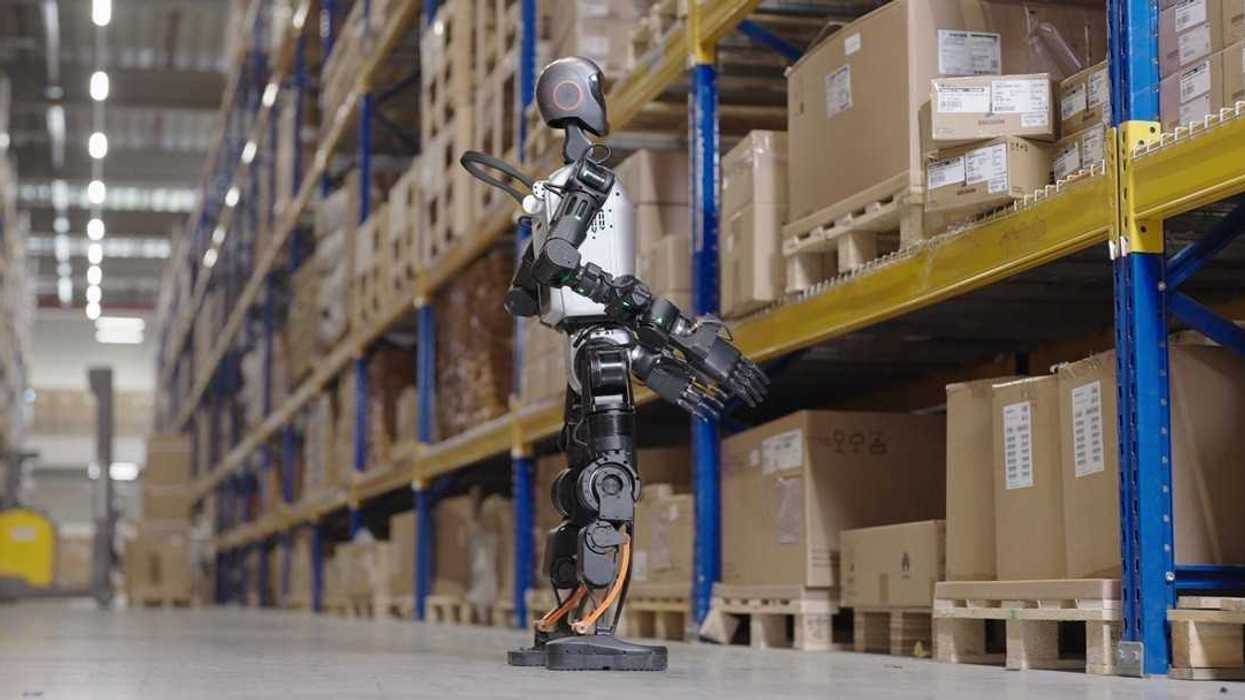
Here is the honest answer: for virtually every current or near-term deployment scenario, sprint speed is irrelevant. The bottleneck in warehouse automation is not locomotion velocity — it is dexterous manipulation, reliable object recognition, and safe human-robot interaction at close range.
Consider the operational math. A humanoid moving through an Amazon fulfilment centre at 1.2 m/s — a brisk walking pace — covers the length of a football pitch in roughly 90 seconds. Moving at 3.3 m/s covers the same ground in 33 seconds. The time saved per task cycle is measured in seconds. Over a full shift, that might compress cycle time by 5-15% under ideal conditions. Meanwhile, the energy cost of running versus walking scales nonlinearly — bipedal running is dramatically less efficient per metre than walking, which compounds battery drain and thermal load on motors.
The metrics that actually drive humanoid robot ROI in operational settings are:
- Manipulation success rate — can the robot reliably pick the right item without dropping it?
- Mean time between failures — how long before a joint fails, a sensor drifts, or software crashes?
- Deployment versatility — can it handle edge cases in an unstructured environment?
- Safety certification — does it meet ISO/TS 15066 cobot safety standards for human-proximate operation?
None of these metrics appear on a sprint leaderboard. Figure AI's Optimus and Agility Robotics' Digit — both slower, less athletically impressive platforms — are arguably further ahead on the dimensions that matter for near-term commercial deployment, precisely because their engineering teams optimised for manipulation and reliability rather than locomotion records.
That said, dismissing sprint research entirely is too blunt. The RL locomotion methods developed for high-speed running transfer directly into more stable, energy-efficient walking gaits. The control theory is fungible. Today's sprint experiment is tomorrow's improved walking stability.
What This Means for Robotics Buyers
If you are evaluating humanoid platforms for warehouse, logistics, or light manufacturing use cases, speed benchmarks should carry minimal weight in your decision matrix. Prioritise dexterity benchmarks, software ecosystem maturity, and the vendor's support infrastructure instead.
Platforms like Unitree's H1 and G1 are competitively priced for research and early commercial exploration — you can browse humanoid robots on Botmarket to compare current availability and pricing across platforms. For established industrial automation needs where bipedal mobility is not required, used industrial robots still offer far better cost-per-task economics for structured environments.
Buyer decision framework for humanoid speed claims:
| Claim | What to ask | Red flag |
|---|---|---|
| "World's fastest humanoid" | At what distance? Peak or sustained speed? | No payload or terrain context given |
| "Completed a half-marathon" | At what pace? With what recovery time? | No comparison to operational duty cycle |
| "RL-trained locomotion" | Trained on what terrain distribution? | Sim-to-real gap not disclosed |
| "Ready for deployment" | Which specific tasks? What success rate? | Speed highlighted instead of manipulation data |
The honest conclusion: robot sprint records are technically impressive and scientifically useful, but they are marketing events first. Buy for the task. Evaluate locomotion only as a baseline capability, not a differentiator.
Frequently Asked Questions
Unitree's H1 holds one of the most cited bipedal speed records at approximately 3.3 metres per second (roughly 12 km/h) in controlled conditions. China's Tiangong Ultra has demonstrated sustained running capability sufficient to complete a half-marathon, though peak sprint speed data is less standardised across platforms. Speed figures vary significantly by terrain, payload, and measurement methodology.
Can a humanoid robot beat Usain Bolt's 100-metre sprint record?
Not currently. Bolt's record equates to a peak speed of 44.7 km/h, roughly four times what the fastest current humanoid platforms achieve in sprint conditions. The gap is closing rapidly due to reinforcement learning advances and improved actuator technology, but mechanical energy density and bipedal gait efficiency remain fundamental constraints. A sub-10-second 100-metre sprint from a humanoid robot is plausible within the next several years, though no specific timeline has been publicly committed to.
Does faster locomotion make a humanoid robot more useful in a warehouse?
Marginally, and not as a primary factor. Warehouse humanoid deployment is constrained by manipulation accuracy, sensor reliability, and safety certification — not walking or running speed. A robot moving at brisk walking pace (1.2-1.5 m/s) can match most warehouse task cycle times if its manipulation and navigation systems are reliable. Energy efficiency at lower speeds also significantly extends operational run time between charges.
Why are companies investing in humanoid robot sprint capability if it has no commercial use?
Sprint research serves two functions: it is a credibility and attention signal that attracts investment and engineering talent, and it stress-tests locomotion subsystems under maximum load conditions. The reinforcement learning policies and actuator designs developed for high-speed running transfer directly into more reliable, efficient walking gaits. The commercial value is indirect but real.
How do humanoid robot speed tests compare to traditional industrial robots?
The comparison is largely category error — traditional industrial robots are fixed to the floor and optimised for repeatability and payload at a single workstation. A six-axis industrial arm can execute a pick-and-place cycle in under one second with sub-millimetre precision, which no humanoid robot approaches. Humanoids trade that precision and speed for mobility and versatility. They are different tools solving different problems.
Sprint records capture headlines. Manipulation benchmarks capture purchase orders.
The humanoid robot field is advancing on both fronts simultaneously — and the locomotion research feeding speed records is genuinely producing better walking robots as a side effect. But for anyone making a deployment or investment decision, the leaderboard to watch is task completion rate and uptime, not the 100-metre dash.
Which metric matters more to you when evaluating a humanoid robot: locomotion speed or manipulation reliability?


Приєднуйтесь до обговорення
Which matters more for your use case: a humanoid that sprints or one that picks reliably?